
What Is Anglicanism? The Master Guide at Holy Cross Anglican Church (Alpine, TX)
Dear Friend, when we walk through the doors of a church, we often carry with us expectations, past experiences, and perhaps a few misconceptions. For many who find their way to Holy Cross Anglican Church in the high desert of Alpine, Texas, the question that lingers most frequently is a simple yet profound one: What is Anglicanism?
This page is our Master Guide to Anglicanism at Holy Cross: a long-form "pillar" resource meant to give you the whole shape of Anglican faith and practice at a high level—clear enough to orient you, but roomy enough that our future cluster posts can go deeper. Why a master guide? Because the modern world is loud and busy, and the soul is easily scattered. We need not more novelty, but a sure path: fasting from confusion, feasting on truth.
Anglicanism, at its best, is a "Reformed Catholic" vision of the Christian life—an ancient way of following Jesus that refuses to choose between the deep roots of the historic Church and the clear light of the Holy Scriptures.
The Heart of the Matter: Reformed Catholicism
To define Anglicanism, we must look at two words that are often treated as opposites but, in our tradition, are inseparable: Reformed and Catholic.
When we say we are "Catholic," we are not referring to the specific modern denomination of the Roman Catholic Church. Rather, we use the word in its original, ancient sense: katholikos, meaning "according to the whole." We are part of the one, holy, catholic, and apostolic Church that has existed since the time of the Apostles. We hold to the historic Creeds (the Apostles’, Nicene, and Athanasian), we celebrate the ancient Sacraments, and we maintain the historic order of Bishops, Priests, and Deacons.
However, we are also "Reformed." During the 16th century, the Church in England underwent a period of reform and renewal. Under the guidance of thinkers like Richard Hooker and Thomas Cranmer, the goal of the English Reformation was not to start a new church, but to restore the old one to its primitive, biblical roots.
As Fr. Erlandson often notes in his teachings, we are the historic Catholic Church as it was planted in the British Isles in the early centuries, later reshaped by the Reformation to ensure that the unmerited favor of God's grace remained the center of our communal life.
The Threefold Cord: Scripture, Tradition, and Reason
How do we know what is true? In a world of "your truth" and "my truth," the Anglican tradition offers a sturdy anchor. Richard Hooker, the great 16th-century theologian, described our authority as a "threefold cord" - - one that is not easily broken.
Holy Scripture: Scripture is the primary and final authority. We believe the Old and New Testaments contain "all things necessary for salvation." Every sermon preached and every prayer offered at Holy Cross must be measured against the Word of God.
Tradition: We do not read the Bible in a vacuum. We listen to the voices of the Early Church Fathers—men like Ignatius, Polycarp, and Augustine—who lived and died for the faith in the centuries immediately following the Apostles. Their exhortation helps us interpret the Bible faithfully and guards us against theological fads.
Reason: God gave us minds to think. We use our reason, enlightened by the Holy Spirit, to apply the timeless truths of Scripture and Tradition to the specific challenges of our day.
The Authority of the Church & Apostolic Succession
If Scripture is our final authority, why talk about the Church’s authority at all? Because Jesus did not leave us a book floating in midair—he gathered a people, taught them, and sent them out. Louis R. Tarsitano describes the Church as a Divine Society: not a religious club built on shared preferences, but Christ’s own body on earth, animated by the Holy Spirit and ordered for mission.
In Anglican life, that means our faith is personal, but never private. We are baptized into a communion that stretches across time and geography—"one, holy, catholic, and apostolic."
The historic episcopate as a "golden thread"
Anglicans speak often about the historic episcopate—bishops in continuity with the apostles—as a kind of golden thread running through the Church’s life. This is not about church politics or spiritual elitism. It’s about recognizable continuity: the same apostolic faith handed down, publicly taught, and sacramentally guarded.
Apostolic succession is not a magic trick; it is the Church’s ordinary way of saying, "This teaching and this sacramental ministry belong to the same Church Jesus founded."
Bishops serve the Church by guarding doctrine, sustaining unity, and ensuring that the sacraments are administered faithfully.
Authority that serves the Gospel (not replaces it)
Here’s a helpful "Reformed Catholic" guardrail: Anglican authority is real, but it is ministerial, not absolute. The Church has authority to proclaim, teach, and discipline—but never to contradict Scripture or to invent a new gospel.
How Anglicans Worship: Liturgy and the Shape of Sunday
There is an old Latin phrase that is vital to the Anglican tradition: Lex Orandi, Lex Credendi. It means "the law of praying is the law of believing." In other words: if you want to know what we believe, come listen to how we pray.
Our worship is not centered on the personality of the preacher or the style of the music, but on the liturgy. Liturgy is simply the Church’s public work of prayer: God speaks, we answer; God gives, we receive. It is countercultural in the best way—because it trains the affections of the heart. It teaches us to kneel in penitence, to stand in glad attention, to confess sin without despair, and to receive mercy without presumption.\n\nAnd because Anglican worship is "Reformed Catholic," our liturgy is both ancient and Gospel-centered: you will hear Scripture read in abundance, you will confess the faith in the Creed, you will confess your sins honestly, and you will be directed—again and again—to Christ’s once-for-all sacrifice and God’s unmerited favor.
The Seven Sacraments (Two and Five)
People often hear that Anglicans have "seven sacraments" and wonder what that means in practice. A simple Anglican way to say it is to distinguish between:
The Two Sacraments of the Gospel (given by Christ with a direct command and a visible sign): Baptism and the Eucharist.
The Five commonly called sacraments (real sacramental ministries of grace in the Church’s life, but not in the same category as the two dominical sacraments): Confirmation, Penance (Confession/Absolution), Matrimony, Holy Orders, and Unction (Anointing of the Sick).
This "Two and Five" distinction helps us stay genuinely catholic—honoring the fullness of Christian practice—while also staying reformed—keeping the Gospel sacraments central and refusing to turn everything into a competing system of merit.
The Two: Baptism and Eucharist (front and center)
Baptism is our entry into the Divine Society—our new birth into Christ, forgiveness of sins, and incorporation into his Body. We baptize because Jesus commands it, and because baptism is God’s act before it is our testimony.
The Eucharist is the Church’s regular meal of thanksgiving and communion: Christ feeding his people with himself, strengthening faith, and drawing us into deeper repentance and joy.
The Five: sacramental life that supports a sacramental people
These five matter because the Christian life is not lived "in theory." It is lived in real bodies, real families, real sickness, real sin, real callings.
Confirmation: a mature owning of baptismal faith, ordinarily connected to the bishop’s ministry and the strengthening of the Spirit for faithful discipleship.
Placeholder for cluster link:Read our deep dive on confirmation and the bishop’s role here. [CLUSTER LINK]Penance (Confession/Absolution): a Gospel gift for burdened consciences—naming sin truthfully and receiving Christ’s forgiveness in a concrete, pastoral way.
Placeholder for cluster link:Read our deep dive on confession in Anglicanism ("all may, none must, some should") here. [CLUSTER LINK]Matrimony: a holy estate in which husband and wife are joined for mutual joy, fidelity, and the raising of children in the faith.
Placeholder for cluster link:Read our deep dive on Christian marriage in Anglican teaching here. [CLUSTER LINK]Holy Orders: the Church setting apart deacons, priests, and bishops to preach the Word and administer the sacraments for the building up of the whole Body.
Unction (Anointing of the Sick): prayer and anointing for healing, endurance, repentance, and peace—especially in illness and at the approach of death.
The 1928 Book of Common Prayer (BCP): Our Common Life
The most recognizable expression of Anglican spirituality is the Book of Common Prayer, and at Holy Cross we utilize the 1928 Book of Common Prayer (BCP). The Prayer Book is not merely a Sunday script; it is a Rule of Life that gives words to our penitence and shape to our praise.
If the secular world disciples us through endless novelty, the Prayer Book re-forms us through steady repetition—fasting from self-invention, feasting on ancient, communal prayer. It provides a rhythm for Morning and Evening Prayer, for the Litany, for the Communion Office, for weddings and burials—so that the Church does not merely react to life, but sanctifies it.
The ACNA catechism (To Be A Christian) describes the Church as a community formed by the Word and Sacraments into a life of faith, hope, and love. The Prayer Book is one of the most practical ways that formation happens: it sets Scripture on our lips, repentance in our posture, and gratitude in our habits—until "church" becomes less of an event we attend and more of a life we live.
Anglicanism as a Rule of Life (Fast & Feast)
When Tarsitano outlines an Anglican life, he is not describing a spiritual hobby; he is describing a pattern—a way of being a Christian that is steady enough to carry us through both struggle and prosperity.
So here’s a very Anglican encouragement: don’t wait until you "feel spiritual" to pray. Pray to become spiritual. The Prayer Book helps with that because it gives us a daily trellis for the vine to climb.
A simple "rule of life" many Anglicans use looks like this:
Daily Office (Morning/Evening Prayer): a daily return to Scripture, confession, creed, and intercession.
Sunday Eucharist: the weekly anchor—Word and Table, confession and thanksgiving, receiving what we could never earn.
Fasting and feasting: we practice self-denial not as punishment, but as discipline—making room for God; and we feast not as indulgence, but as thanksgiving—receiving God’s gifts with joy.
Regular confession and repentance: not living in shame, but walking in the light—quick to repent, quick to forgive, quick to start again.
The Church Calendar: Sanctifying Time
Anglicans do not only ask, "What do we believe?" We also ask, "What time is it—spiritually speaking?" The Church Calendar is one of the Church’s gentlest gifts: it trains us to live by Christ’s story rather than by the world’s schedule.
Year by year, we are led through Advent longing and Christmas joy; through Epiphany light and Lenten penitence; through Easter feasting and Ascension hope; through Pentecost mission and the common faithfulness of Trinity season. The secular calendar often feels like a treadmill—always accelerating, never satisfying. The Christian calendar is a pilgrimage: it calls us back to what is eternal.
The Eucharist: The Center of Christian Worship
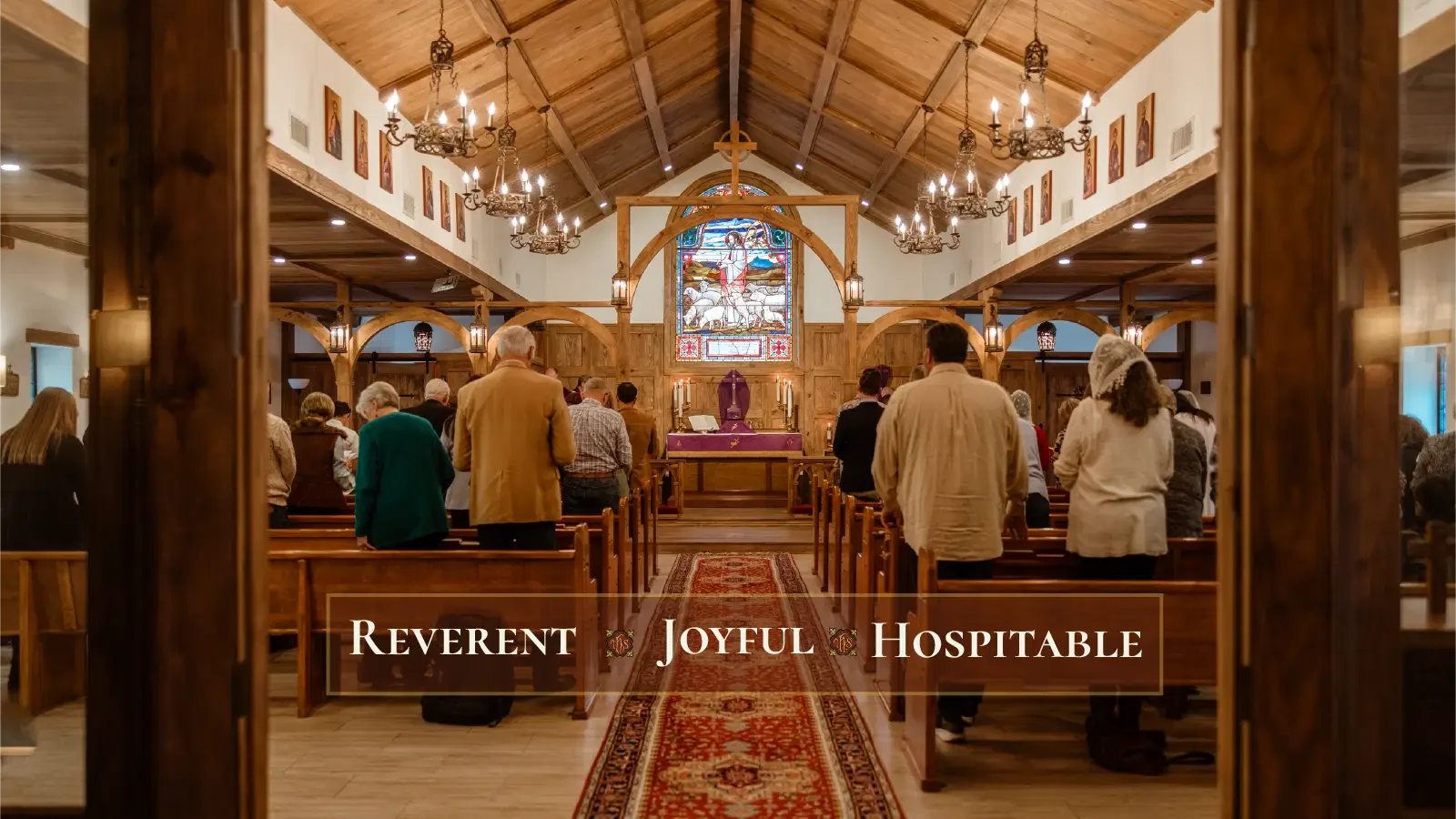
The beating heart of Sunday worship is the Holy Eucharist (Holy Communion). Why do we place the altar at the center? Because Christianity is not merely an idea to be admired, but a life to be received. In the Eucharist we come, not as the strong and self-sufficient, but as the needy. We confess, we are absolved, we hear the Word, we pray, we give thanks, and we receive—trusting Christ’s indwelling presence and His complete mastery over sin and death. This is not a reward for the spiritually impressive; it is medicine for the soul.
The ACNA catechism teaches us to expect the Eucharist to do what God promises: to strengthen us in faith, renew us in grace, and bind us to Christ and to one another. That’s why we come forward with open hands. We are not performing for God; we are receiving from God. And then we are sent back out—fed, forgiven, and steadied—to love our neighbors in real life.
The Caroline Divines & the Beauty of Holiness
Holy Cross is "high church" in the best sense: reverent, sacramental, and rooted. That identity didn’t drop out of the sky. A major stream feeding Anglican worship and spirituality comes from the 17th century, often called a kind of Anglican "golden age," when pastors and theologians emphasized what they loved to call the beauty of holiness.
When we mention the Caroline Divines, we’re talking about an Anglican tradition shaped by thinkers and churchmen like:
Richard Hooker (often paired with this movement as a guiding voice on Anglican theology and order),
Lancelot Andrewes (known for deeply biblical preaching),
William Laud (associated with reforming worship toward reverence and continuity).
What "beauty of holiness" means (and what it doesn’t)
"Beauty of holiness" is not about spiritual aesthetics for their own sake. It is about giving God fitting worship—worship that tells the truth about who God is and who we are.
We kneel because God is holy.
We confess because we are sinners.
We sing because God is good.
We come to the altar because God feeds his people.
This is also one place we gently avoid modern confusion: reverent worship does not require us to imitate every later medieval development or to pretend the English Reformation never happened. Anglicanism’s beauty is not borrowed authority; it is Gospel-shaped reverence.
The Oxford Movement (Tractarianism)
In the 19th century, another major renewal movement rose within Anglicanism: the Oxford Movement, often associated with "Tracts for the Times" and sometimes called Tractarianism.
At its best, the Oxford Movement was a call back to the Church’s catholic identity—specifically the Church Fathers, the sacraments, and the visible unity of the Church—at a time when Christianity was being squeezed into either mere moralism or mere political utility.
Recovery without confusion
We can be grateful for the Oxford Movement’s recovery of catholic seriousness while also being aware of the dangers that can accompany it. The goal is neither "Anglo-Papalism" (treating Anglicanism as a Roman imitation) nor a vague "anything goes" Anglo-Catholicism.
A Reformed Catholic Anglican approach looks like this:
Catholic: We love the creeds, the fathers, the sacraments, and the historic episcopate.
Reformed: we submit to Scripture as final authority, sincerely embrace justification by grace through faith, and refuse to add new dogmas as if they were necessary for salvation.
Anglican Theology and the Thirty-Nine Articles: Guardrails, Not Guesswork
While we are a hospitable church that welcomes seekers and skeptics alike, we are not a church without convictions. Anglicanism has a theological "grammar"—a shared way of speaking faithfully about God—so that we are not carried about by every passing trend.
The Thirty-Nine Articles of Religion serve as our historic formularies and guardrails. They help keep the Gospel clear: that we are saved by grace, through faith, because of Christ’s complete mastery; and that good works are fruits, not wages. They also clarify how Anglicans speak about the Church, the Sacraments, and the authority of Scripture.
One of the strengths of the ACNA catechism (To Be A Christian) is that it gives plain-language answers to core questions—Who is Jesus? What is the Gospel? What are the sacraments? What is the Church for? Used well, catechesis doesn’t replace the Articles or the Prayer Book; it supports them by helping Christians learn to speak the faith with clarity and confidence.
Whether we are reading a homily for Lent or celebrating the Feast of the Epiphany, these standards help us remain biblically sound and historically rooted.
Multi-Generational Worship (Including Children and Infants)
One of the first things visitors notice at Holy Cross is that we worship as a whole parish family. That includes children—and yes, infants.
In some churches, kids are treated as a distraction from "real worship." In the Anglican vision, it’s almost the opposite: children belong where the covenant family belongs—around the Word and the Table. They learn the faith the way we all do: by hearing Scripture, by watching repentance and forgiveness, by singing, by kneeling, by making the sign of the cross before they can explain it, by seeing bread and wine lifted with prayer, and by growing up with the sense that God is not an idea but a living Lord who claims a people.
Why this is central (not optional)
Because baptism incorporates families into the Church: when we baptize, we are not just blessing an individual moment; we are receiving a person into Christ’s Body. The Church then becomes a real spiritual household.
Because liturgy forms us over time: kids may not understand every word today, but they are being shaped by the repeated prayers of the Church.
Because Jesus welcomes children: the Church should not be stricter than her Lord.
And practically, we want parents to know: you don’t need to apologize for having children in church. Bring them. Sit near the front if it helps them see. Whisper explanations. Step out if you need to. Then come right back in. We’re not here to perform; we’re here to be formed together.
Why Anglicanism Matters in Alpine, Texas
You might ask, "Why would a tradition with roots in ancient England and 16th-century theology matter to a Christian community in Alpine, TX?"\n\nThe answer lies in our deep hunger for something that lasts. We live in a transient age. People move, technology changes, and even the most popular "modern" church styles of ten years ago now feel dated. Anglicanism offers something different: a sense of timelessness.
At Holy Cross, we are a family of believers—from students and professionals to retirees—who have found that the ancient paths are the most life-giving. We find that the rhythm of the liturgical year provides a structure that the secular calendar cannot offer. It calls us away from the terrifying emptiness of a life lived only for the self and into a communal identity of shared moral responsibility and joy.
An Invitation to Come and See
Perhaps you are a lapsed Christian who felt burned by a church. Perhaps you are a seeker who is tired of random devotions and is looking for a historic and liturgical home. Or perhaps you are simply curious about the a faith that has stood the test of two millennia.
We invite you to join us. Come experience reverent worship. Come hear the Word of God read and preached with clarity. Come and find that God is eager to forgive, to heal, and to show you the unmerited favor of His grace.
If you are new, here are a few simple next steps:
Join us for Holy Communion (Sunday at 10:30 AM).
Come a bit early for Sunday School (Sunday at 9:30 AM)—including children and infants.
If you need a mid-week reset, come for Evening Prayer (Wednesday at 6:00 PM) and Bible Study (Wednesday at 6:30 PM).
For a steady weekday rhythm, join Morning Prayer (Monday–Friday at 7:30 AM) (coffee afterward).
As you step into our sanctuary, leave behind the busyness of the world. Let the affections of your heart be stirred by the ancient prayers. Let us walk this path together—fasting from the vanities of the age, feasting on the goodness of the Lord.
Amen.